Definitions across nine capability families.
OMNI-REASON / A VISUAL REASONING BENCHMARK
A world to see.
A world to reason about.
OmniReason.
Beyond recognizing a frame.
Understanding what moves, what changes,
and what comes next.
340 tasks 9 capability families One atlas
THE WORLD BEHIND THE WORDS IS ALREADY MOVING.INPUT → TARGET · REAL TASK EXAMPLES
A WORLD OF VISUAL QUESTIONS
Follow a question
through the world.
A ball changes direction. A camera moves through space. Weather grows into a storm. Explore the scenes and transformations that make each task distinct.
ONE WORLD. A DIFFERENT WAY TO SEE IT.
SWIPE TO EXPLORE
INPUT What the model seesWhat the task asks for TARGET
INPUT
TARGET
Drag the line. Reveal the transformation.
TASK 47 / UNDERSTAND SPACE
See the depth in a scene.
Turn each frame into a map of near and far, without losing the scene’s geometry.
DRAG THE LINE TO COMPARE · SWIPE THE CARD TO EXPLOREMINI INPUT → TARGET · NOT A MODEL OUTPUT
32 windows into the atlas. Swipe in either direction — the last flows back to the first.
Open any task to inspect its evidence.
02 / FROM PIXELS TO STRUCTURETRACKING · GEOMETRY · VIEWPOINT
Not just pixels.
Paths. People. Space.
Follow the same points through time.
Recover the structure behind what you see.
Released Mini task examples · short browsing excerpts · targets are not model predictions.
THE OMNI-REASON TASK MAP
One model.
Nine capabilities.
Omni-Reason organizes 340 video tasks into nine capability families. Each node opens that family in the task wall, so you can move from the overview straight into examples.
340tasks in the atlas
9capability families
170evaluated tasks
Choose a family to filter the task wall.
Counts show tasks in the atlas. 170 of the 340 tasks are evaluated in Full170.
02 / CHANGE THE SCALEMEDICINE · WEATHER · ASTRONOMY
From a
heartbeat
to a star.
A moving body. An evolving storm.
A different view of the Sun.
Reasoning reaches beyond the everyday.
OMNI-REASON / DATASET
340 tasks.
One shared video interface.
Explore the full task directory. Each card opens the task instruction and its public Input, Target and any visual Reference examples. The Target is the expected result for comparison; it is not given to the model.
Example counts vary across tasks.
Five evaluation samples per benchmark task.
Seven model IDs across the 850 Bench170 samples.
TASK MAP / CAPABILITY FAMILIES
Nine ways to work with video.
Omni-Reason organizes 340 task definitions into nine families and 34 sub-capabilities. The counts below are tasks in the directory, not generators or benchmark samples.
340TASK DEFINITIONS
9CAPABILITY FAMILIES
34SUB-CAPABILITIES
Loading capability families…
Separate inventories. These are Task Atlas annotation examples, not automatically the same samples as Mini Gallery or Bench170. Exact prompts are available for the 170 Bench170 release tasks; the TV2V repository main branch has prompt definitions for 18 matching Task IDs, including five outside Bench170. Task 1 has 26 prompt profiles. Repository prompts keep their pipeline status, including not_ready; the RV2V main branch currently has no task-specific prompts. Other entries show the published task definition summary and mark the original prompt as unavailable. Input is supplied to the model; Target is the expected result for comparison; Reference, when present, provides optional visual guidance.
TASK DIRECTORY / 340 TASKS
Find a task. Open its examples.
Browse all tasks by name, capability family or video interface. Select any card to inspect its prompt and available annotation examples.
Loading all 340 dataset tasks…
OMNI-REASON / BENCHMARK v1.1
Benchmark
Browse the same 170 evaluated tasks and five held-out samples per task. Select a task and sample to compare its Input, Target, optional Reference, and fixed-version outputs from seven open-source models. Mini100 scores are shown separately in Leaderboard.
Read quality labels with the record identity. Playback does not establish task correctness. Each output is bound to a task, sample, model and immutable version. Open audit manifest ↗
Sample
Choose Benchmark to load the Full170 manifest…
OMNI-REASON / EVALUATION RESULTS
Leaderboard
Task completion and visual similarity are reported in separate result sets. Each section names its task scope, sample count, model identity and evaluation method.
CLOSED-MODEL COMPARISON · 2026-10-28
One sample. 141 shared tasks.
The report compares K120, seven open-source models and four closed models under one GPT-6 Astra judge protocol, using sample 000001 for each task. The set was selected because all four closed models returned videos for those tasks, not by score.
| Rank | Model | Pass / 141 | Pass rate | 95% Wilson CI | TV2Vn=121 | RV2Vn=20 |
|---|---|---|---|---|---|---|
| 01 | K120 OURS IN SOURCE REPORT | 79 | 56.0% | 48–64% | 70 | 9 |
| 02 | Kling O3 Standard | 34 | 24.1% | 18–32% | 32 | 2 |
| 03 | Seedance 2.5 | 28 | 19.9% | 14–27% | 25 | 3 |
| 03 | Gemini Omni Flash 1.0 | 28 | 19.9% | 14–27% | 28 | 0 |
| 05 | MiniMax H3 | 16 | 11.3% | 7–18% | 11 | 5 |
| 06 | Cosmos3 Super | 12 | 8.5% | 5–14% | 9 | 3 |
| 07 | Cosmos3 Nano | 10 | 7.1% | 4–13% | 7 | 3 |
| 08 | Grok Imagine Extend | 7 | 5.0% | 2–10% | 6 | 1 |
| 08 | HY-OmniWeaving | 7 | 5.0% | 2–10% | 6 | 1 |
| 10 | LTX-2.3 IC-LoRA | 4 | 2.8% | 1–7% | 3 | 1 |
| 10 | LTX-2.3 Extend | 4 | 2.8% | 1–7% | 4 | 0 |
| 10 | Wan-VACE 14B | 4 | 2.8% | 1–7% | 4 | 0 |
How to read this result. A pass rate is Pass ÷ (Pass + Fail) on the shared 141-task set. Each task contributes one sample, ID 000001. The judge outcomes have not been validated against human labels, and one sample per task does not show within-task variation. This result is separate from the paper's Table 3 and automatic video-similarity scores below.
Judge protocol and limitations
Scoring used GPT-6 Astra (reasoning high, core-only) with V2V-GPT-Judge protocol. The 141 tasks comprise 121 TV2V and 20 RV2V examples. The supplied report records zero insufficient-evidence, execution-error or missing-score cases in this common set. It also reports 95% Wilson intervals and paired exact sign tests. The judge results have not been validated against human labels; one sample per task does not measure within-task variation. The report names the Omni-Reason system as “K120”; its mapping to “Omni-Reason-1” in Table 3 or “Omni-Reason A10K” in the Main170 similarity report is not specified here.
PAPER TABLE 3 · TASK COMPLETION
Task completion rates (%)
Instruction-following outcomes, reported separately from video-similarity metrics. Bold marks the highest available rate in each column; ties are retained.
Full benchmark
Task Pass Rate · a task passes when at least 3 of its 5 samples pass
| Model | Overalln=170 | Percep.n=18 | Motionn=28 | Geom.n=21 | Viewn=12 | Restoren=31 | Editn=16 | Futuren=16 | Reasonn=17 | Cross-m.n=11 |
|---|---|---|---|---|---|---|---|---|---|---|
| Omni-Reason-1 OURS | 57.1 | 50.0 | 39.3 | 81.0 | 25.0 | 93.5 | 68.8 | 25.0 | 29.4 | 72.7 |
| MiniMax H3 | 11.2 | 5.6 | 3.6 | 9.5 | 0.0 | 12.9 | 25.0 | 25.0 | 0.0 | 27.3 |
| Cosmos3 Super | 6.5 | 0.0 | 3.6 | 0.0 | 0.0 | 16.1 | 6.3 | 25.0 | 0.0 | 0.0 |
| HY-OmniWeaving | 4.1 | 0.0 | 0.0 | 0.0 | 0.0 | 3.2 | 37.5 | 0.0 | 0.0 | 0.0 |
| Cosmos3 Nano | 4.1 | 0.0 | 3.6 | 0.0 | 0.0 | 12.9 | 6.3 | 6.3 | 0.0 | 0.0 |
| Wan VACE 14B | 3.5 | 5.6 | 0.0 | 0.0 | 0.0 | 3.2 | 6.3 | 18.8 | 0.0 | 0.0 |
| LTX-2.3 Dev | 2.4† | 0.0 | 3.6 | 0.0 | 0.0 | 3.2 | 0.0 | 12.5 | 0.0† | 0.0 |
| LTX-2.3 Extend | 1.8† | 0.0 | 0.0 | 0.0 | 0.0 | 0.0 | 6.3 | 12.5 | 0.0† | 0.0 |
Overall pools tasks within the setting; category denominators are shown in the column headings. † Each LTX model has one unresolved Full reasoning task; only confirmed task passes are counted. Input-adaptation limits are described in Appendix E.5.
Mini benchmark
Sample Pass Rate · one sample per task on 141 fixed common tasks
| Model | Overalln=141 | Percep.n=15 | Motionn=23 | Geom.n=16 | Viewn=10 | Restoren=30 | Editn=10 | Futuren=14 | Reasonn=13 | Cross-m.n=10 |
|---|---|---|---|---|---|---|---|---|---|---|
| Omni-Reason-1 OURS | 58.9 | 46.7 | 43.5 | 81.3 | 40.0 | 83.3 | 80.0 | 28.6 | 38.5 | 70.0 |
| MiniMax H3 | 11.3 | 6.7 | 0.0 | 12.5 | 10.0 | 16.7 | 20.0 | 7.1 | 0.0 | 40.0 |
| Cosmos3 Super | 8.5 | 0.0 | 4.3 | 0.0 | 0.0 | 16.7 | 20.0 | 21.4 | 0.0 | 10.0 |
| HY-OmniWeaving | 5.0 | 0.0 | 4.3 | 0.0 | 0.0 | 6.7 | 40.0 | 0.0 | 0.0 | 0.0 |
| Cosmos3 Nano | 7.1 | 0.0 | 4.3 | 0.0 | 0.0 | 10.0 | 30.0 | 21.4 | 0.0 | 0.0 |
| Wan VACE 14B | 2.8 | 6.7 | 0.0 | 0.0 | 0.0 | 3.3 | 10.0 | 7.1 | 0.0 | 0.0 |
| LTX-2.3 Dev | 2.8 | 0.0 | 0.0 | 0.0 | 0.0 | 0.0 | 20.0 | 7.1 | 7.7 | 0.0 |
| LTX-2.3 Extend | 2.8 | 0.0 | 0.0 | 0.0 | 0.0 | 3.3 | 10.0 | 7.1 | 7.7 | 0.0 |
Additional API models · Mini only
- Seedance 2.5Judgments pending
- Gemini Omni FlashJudgments pending
- Grok Imagine VideoJudgments pending
- Kling O3 StandardJudgments pending
Overall pools tasks within the setting; category denominators are shown in the column headings. The Mini pass-rate set contains 141 common samples; it is distinct from the 100-task Mini100 similarity-score file below.
Model identity: Table 3 names the evaluated system Omni-Reason-1. Its checkpoint mapping to the “Omni-Reason A10K” row in the separate Main170 automatic-metrics report is not specified here.
BENCHMARK v1.1 TASK SCOPE · MAIN170 REPORT
Main170 automatic metrics
Eight model rows · 170 tasks × 5 samples · six metrics. Omni-Reason A10K leads all six metrics in this supplied report.
| Model | PSNR ↑dB | MSE ↓×10⁻³ | SSIM ↑ | MS-SSIM ↑ | LPIPS ↓ | CLIP ↑ |
|---|---|---|---|---|---|---|
| Cosmos3 Nano | 12.52 | 102.048 | 0.5095 | 0.5174 | 0.5162 | 0.7762 |
| Cosmos3 Super | 13.13 | 105.705 | 0.5314 | 0.5428 | 0.4918 | 0.7925 |
| HY-OmniWeaving | 13.80 | 97.578 | 0.5664 | 0.5881 | 0.4848 | 0.8038 |
| LTX-2.3 Dev | 10.49 | 140.578 | 0.4459 | 0.3696 | 0.5997 | 0.7146 |
| LTX-2.3 Extend | 13.20 | 82.244 | 0.5268 | 0.4586 | 0.5386 | 0.8009 |
| MiniMax H3 | 13.32 | 88.187 | 0.5241 | 0.4904 | 0.4962 | 0.8320 |
| Wan-VACE 14B | 14.40 | 74.060 | 0.5947 | 0.6193 | 0.4804 | 0.8160 |
| Omni-Reason A10K OURS | 21.42 | 18.368 | 0.7557 | 0.7960 | 0.2937 | 0.9131 |
Coverage: five metrics cover 170 tasks / 850 samples; MS-SSIM covers 165 tasks / 825 samples. The supplied report notes 48 paired results were recomputed and the original results retained. Metrics compare outputs with Targets; they do not establish task completion.
BENCHMARK v1.0 · MINI100 SCORE FILES
Mini100 leaderboard
Published macro-averaged similarity scores for the v1.0 profile of 100 tasks × one sample. Per-model n shows how many samples had returned scores; coverage varies. This score set is separate from the Main170 report.
| Rank | Model | Samples | PSNR ↑ | SSIM ↑ | MS-SSIM ↑ | LPIPS ↓ | CLIP ↑ |
|---|---|---|---|---|---|---|---|
| Loading published metrics… | |||||||
The 70 v1.1 additions and Full170 five-sample outputs are not included here. The Samples column reports each model’s scored coverage (88–100 in this published file). Omni-Reason has no entry in the published Mini100 v1.0 score file; its available result is in the Main170 report above. Mini100 scores are a separate inventory from Full170 videos.
Download source CSV ↗Scoring scope and method
PSNR uses rgb-psnr-v1: per-pixel MSE over all frames in [0,1], averaged within each task and then equally across scored tasks. Predictions are resampled to the target resolution, frame rate and frame count. Other metrics use the same aligned pairs. The copy-input baseline compares Input directly with Target.
OMNI-REASON / REFERENCE
BibTeX
Copy the BibTeX entry below to cite the Omni-Reason paper.
LATEX REFERENCEomni_reason.bib
@misc{omni_reason,
  title  = {Omni-Reason: A General Video Model That Could Solve 100 Computer Vision Tasks},
  author = {Wang, Maijunxian and Zhao, Zehong and Gao, Qingying and Jiang, Zhengze and Zhang, Yilan and Qin, Huayi and An, Siyuan and Ju, Hanxuan and Wu, Yuhan and Wang, Yue and Huang, Junruo and Zhao, Lunyu and Zhao, Xin and Liu, Huayu and Li, Yihan and Wu, Jiarui and Xiao, Xintong and Wu, Shuqi and Liu, Jiajun and Luo, Evan and Zhou, Yikai and Song, Ziyan and Zhang, Haotian and Biran, Yahav and Gandhi, Kavish and Singh, Adarsh and Gray, John and Agha-Ebrahim, Armin and Burtoft, Jim and Luo, Dezhi and Yu, Fengyuan and Ji, Ran and Deng, Hokin}
}
OMNI-REASON / RUN
Coming soon
01 / THE MOTION GALLERY
Different worlds.
The same question: can it reason?
32 starting points, from sport to science.
Input → target, playing as you browse.
Explore all 340 tasks in the universe ↓
No matching featured task. Search the complete 340-task universe ↓
32 featured Mini examples. A starting point, not the full scope.Keep exploring: all 340 tasks ↓
02 / THE COMPLETE TASK UNIVERSE
340 tasks.
Every point opens a world.
Nine capability families. One connected view.
Pick a point, or search the complete directory.
340 TASKS / 9 FAMILIES
Colors indicate the published capability families. Point positions are a browsing layout, not a measure of similarity, difficulty or model performance. This is the frozen 340-task atlas; 170 tasks have Full170 model outputs.
Browse and search all 340 tasks +
THE EXAMPLES EXPLAIN THE QUESTION. THE OUTPUTS SHOW THE RESPONSE.
Look closer.
Judge for yourself.
Explore the original model outputs with their quality notes and input-protocol disclosures. A playable result is not necessarily a correct one.
RESEARCH / THE PAPER
Omni-Reason:A General Video Model That Could Solve 100 Computer Vision Tasks
THE QUESTION / THE APPROACH / THE EVIDENCE
Can one video model carry out very different visual operations by following a task-specific instruction? Omni-Reason studies this with a shared video-to-video interface: provide an Input, a Prompt and sometimes a Reference; the model returns a video response to compare with the task’s Target. This page walks through the task design, dataset, model, evaluation and what the reported results can—and cannot—establish.
Keep the inventories distinct. The full dataset has 340 task definitions. Bench170 selects 170 tasks and five held-out samples per task. The paper’s Mini100 setting uses one sample from each of 100 tasks; the separate Table 3 pass-rate report uses 141 fixed common samples. These are different evaluation scopes.
A common task language
Convert diverse visual operations into Input, Prompt, optional Reference and Target records, while retaining the rules that define a correct answer.
One video generator
Give each conditioning stream an explicit role and temporal relationship so the same transformer can learn different operations.
Task-specific evidence
Study whether an output performs the requested operation and preserves the evidence it depends on, alongside visual-similarity measurements.
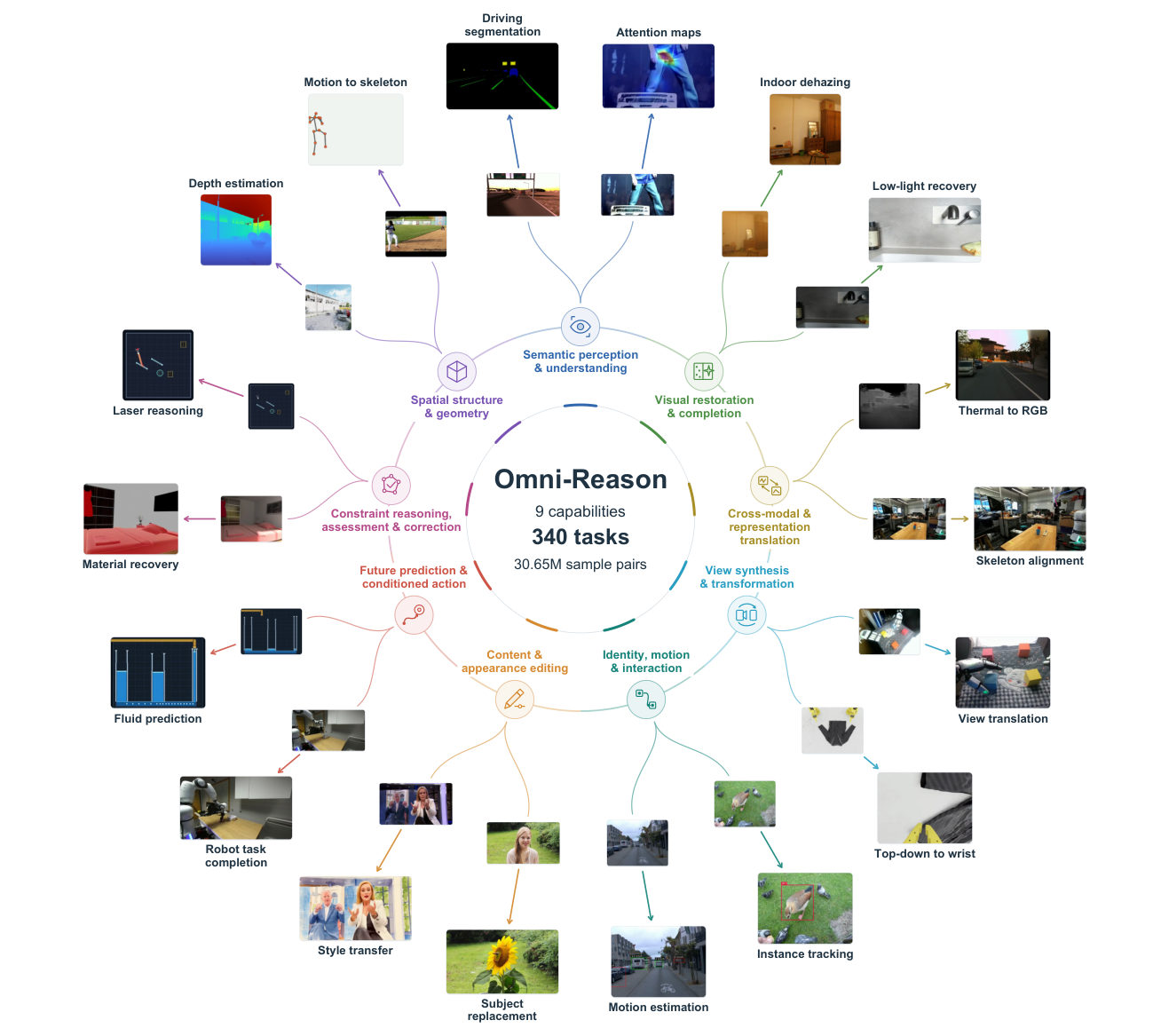
How to read Figure 1. The colored branches group representative operations into nine capability families. The thumbnails illustrate task types; they are not model comparisons. The center summarizes the shared video-to-video framing and dataset scale, not an evaluation score.
ABSTRACT
Can one video model perform many different computer-vision tasks when told what to do in a prompt? Omni-Reason studies this by expressing each task as a video-generation problem: provide the visual evidence and instruction, then generate a video that demonstrates the requested operation. The challenge is temporal and relational. A useful answer may need to preserve an object, follow the same point through motion, change a viewpoint or show a plausible future state.
TASK FORMAT
What the model receives and generates
For each task, the model receives an Input video and a task-specific Prompt. Some tasks also provide a Reference image or video for extra guidance. The model generates a video response, which can then be compared with the task’s Target. For example, “unfold this paper in reverse order” and “track this exact point” use the same input-and-prompt format but ask for different visual operations.
InputWhat the model sees+PromptWhat it must do+ReferenceOptional guidance→Generated videoThe model’s response
The Target is the expected answer used for training or comparison; it is not given to the model as an input.
The research question. Can one model follow different instructions while respecting the specific objects, relationships and changes in each input video? The benchmark makes that question concrete by defining what the model sees and what a correct video should show for each task.
Many vision tasks already describe a transformation between visual states: restore a damaged frame, track an object through time, change a viewpoint or predict what happens next. A generated video can represent these answers while preserving their temporal structure.
The same output format hides different rules. Tracking must preserve identity on the Input timeline; prediction must continue beyond it; editing must change only what the Prompt allows. A plausible-looking clip can still violate the task.
DATA / TASK INTERFACE & COVERAGE
Each task pairs a video with an instruction and an expected result. The collection contains 340 task definitions; Bench170 selects 170 tasks and five held-out examples per task. Some tasks use only a video and prompt, while others also provide a reference. The Target is the expected result used for comparison, not an input to the model.
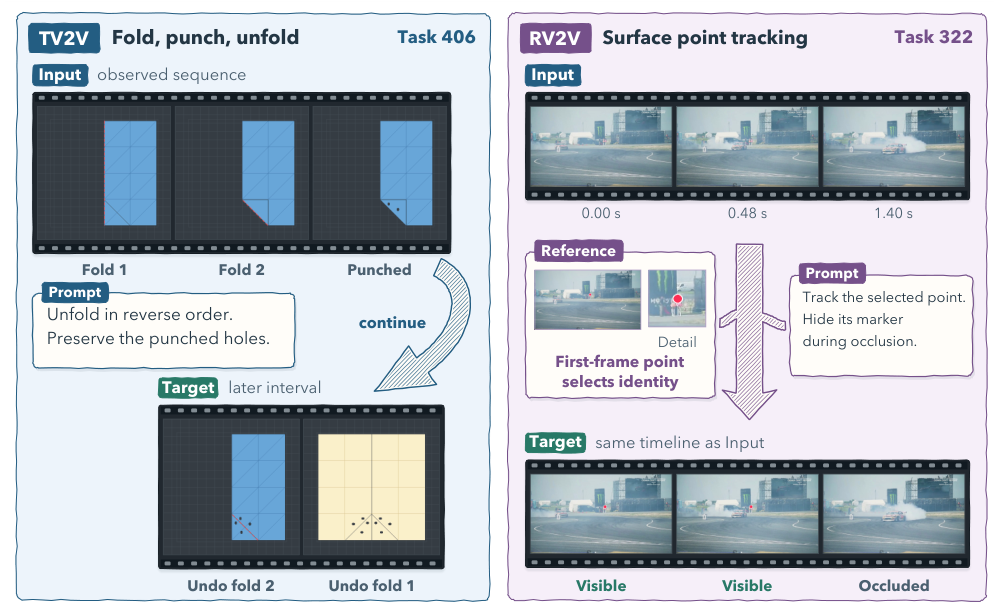
How to read Figure 2. In the paper-unfolding example, the Target is a later interval: the model must reverse the fold order and preserve the punched holes. In point tracking, a first-frame Reference identifies which point to follow, while the Target marks that same point frame by frame. A Reference specifies the query; it does not provide the future trajectory.
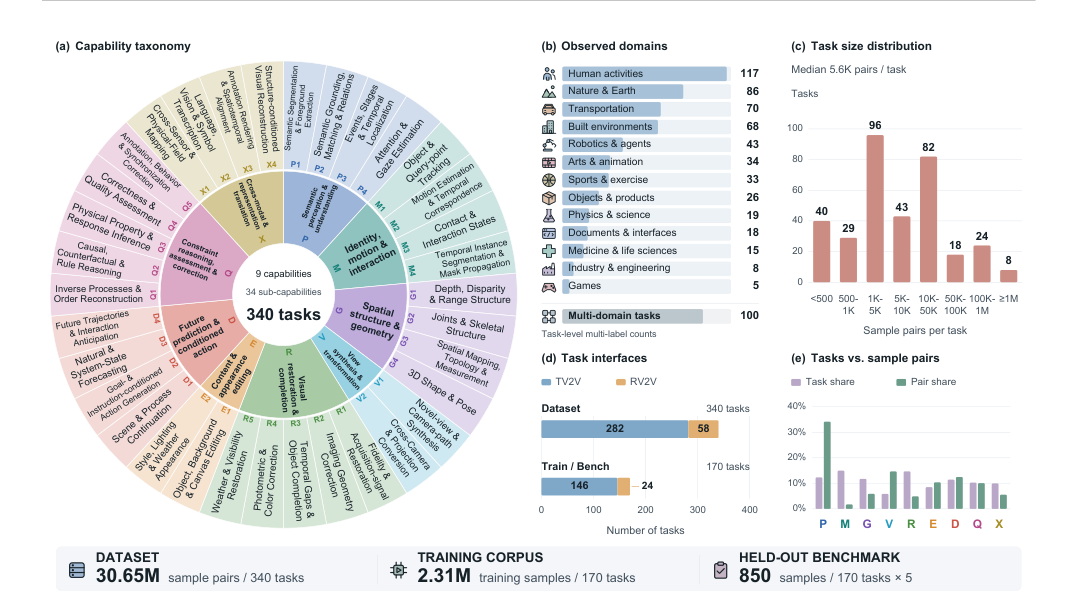
How to read Figure 3. Panel (a) names the nine families and 34 sub-capabilities; its equal-angle sectors are a taxonomy, not proportions. Panel (b) counts scene domains, which can overlap because one task may cover several domains. Panel (c) shows a long-tailed sample distribution: the median task has 5,634 canonical pairs, while a small number of tasks contribute many more. Panels (d) and (e) separate task counts from sample-pair counts. The 170-task subset is 146 TV2V tasks and 24 RV2V tasks; its 850 benchmark examples are separate from the 2.31M-record training corpus.
WHY SELECT 170 TASKS?
The experimental subset prioritizes visual operations and inference while accounting for duration and inference cost. Tasks dominated by textual explanations, or too costly for this round, remain in the full collection. The selected subset spans all nine families and 31 of the full collection’s 34 sub-capabilities.
FULL DATASET / BENCH170
Coverage by capability family
Counts use each task’s primary family. The benchmark column is a subset of the full task directory.
| CAPABILITY FAMILY | FULL · 340 TASKS | BENCH170 |
|---|---|---|
| Semantic perception and understanding | 42 | 18 |
| Identity, motion and interaction | 51 | 28 |
| Spatial structure and geometry | 40 | 21 |
| View synthesis and transformation | 20 | 12 |
| Visual restoration and completion | 50 | 31 |
| Content and appearance editing | 29 | 16 |
| Future prediction and conditioned action | 39 | 16 |
| Constraint reasoning, assessment and correction | 35 | 17 |
| Cross-modal and representation translation | 34 | 11 |
Family counts sum to 340 tasks in the full collection and 170 in Bench170. They count task definitions, not sample pairs or model outputs.
The complete task collection. The current public showcase has 1,697 task examples; tasks do not all have the same number of examples.
Encoded training records prepared from the selected 170 tasks. These records are not the held-out benchmark examples.
Five held-out examples for each of 170 tasks. This is the fixed evaluation scope described in the paper.
Seven open-source model IDs × 850 samples. The Main170 metric report has eight rows; the report and video manifest are separate inventories.
Nine capability families
The full collection spans 34 sub-capabilities and 13 observed domains. One hundred tasks span at least two domains. Figure 3 reports task share and sample-pair share separately; these distributions are not interchangeable. A large sample share means more examples, not more task types.
Pipeline + Generator
Pipeline converts and standardizes existing sources. Generator creates paired examples from specified scenes, parameters and rules. Both routes produce the shared task format.
METHOD / MODEL
Omni-Reason uses a video diffusion transformer to generate a response video from the task instruction. It can condition on an input video and, when the task needs it, a reference image or video. The model is trained to distinguish these input streams from the video it must generate, so one model can handle different visual operations.
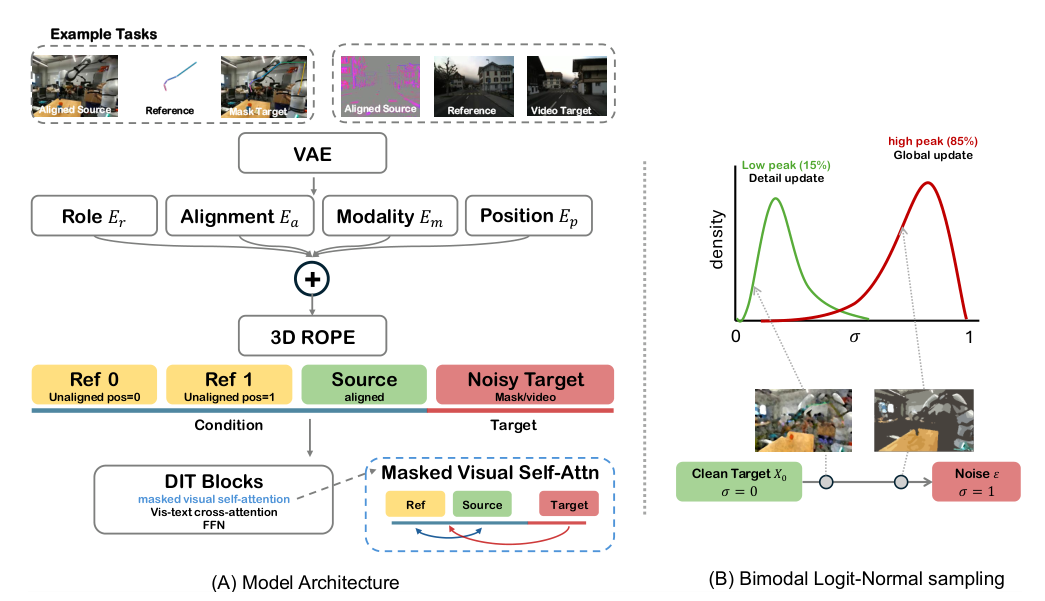
How to read Figure 5. On the left, Role, Alignment, Modality and Position tell the video transformer what each visual stream represents and how it relates in time. This matters when, for example, a reference image identifies an object but is not synchronized with every generated frame. On the right, the two noise peaks combine broad generation steps (85%) with low-noise refinement (15%) for spatially precise details such as masks, lines and boxes.
Label every visual stream
Each visual token is marked by its role (source, reference or target), temporal alignment, modality (video or mask) and slot. The draft model accepts at most one source video and up to three references.
Use evidence without corrupting it
Directed attention allows source and reference conditions to inform one another and the generated target. Noisy target tokens cannot flow back into the clean condition representations.
Generate across scales of detail
Flow matching drives the video transformer from noise toward a target video. A 15% low-noise component gives additional training attention to precise structures such as masks, thin lines and boxes.
Time and viewpoint matter. Alignment-aware 3D positional encoding distinguishes a source synchronized with the Target from an unaligned Reference. This lets a task say whether the output should correspond frame by frame or depict a later interval.
Training setup in the draft. The paper describes a 13.1B-parameter, 48-layer video DiT trained on one AWS trn2.48xlarge node with 16 Trainium2 chips, using TP4 × FSDP16 parallelism. These are the reported research-training details, not hardware requirements for running the website or released inference code.
RESULTS / TASK COMPLETION + VISUAL SIMILARITY
We report two kinds of evidence. Task-pass judgments ask whether the requested operation was completed; full-reference metrics measure resemblance to the Target. They have different scopes and should be read separately.
Full Task Pass Rate · 170 tasks × 5 samples. A task passes when at least 3 of its 5 samples pass.
Sample Pass Rate · 141 fixed common samples, one sample per task. This is not the Mini100 similarity table.
Separate reports and versions. The Main170 automatic-metrics report covers 170 tasks × 5 samples and eight model rows. It names its model row “Omni-Reason A10K”; Table 3 names the task-completion model “Omni-Reason-1”, and their checkpoint mapping is unspecified. The paper draft’s Mini100 tables for automatic similarity and human preference contain no numeric results. The 141-sample Table 3 Mini result and the website’s Mini100 score file are separate inventories.
PSNR ↑21.42 dBhigher is better
MSE ↓18.368 × 10⁻³lower is better
SSIM ↑0.7557higher is better
MS-SSIM ↑0.7960165 tasks / 825 samples
LPIPS ↓0.2937lower is better
CLIP ↑0.9131higher is better
READING THE RESULT
The A10K row leads all six similarity columns in the supplied Main170 report. This supports better agreement with the reference videos on that report’s scope. A generated video can still miss a task constraint, so completion judgments and example inspection remain necessary.
Explore model comparisons and report versionsMetric coverage. Five metrics cover 170 tasks / 850 samples; MS-SSIM covers 165 tasks / 825 samples.
Read the direction. Higher is better for PSNR, SSIM, MS-SSIM and CLIP. Lower is better for MSE and LPIPS.
ANALYSIS / WHAT THE SCORES SAY
The six metrics measure different kinds of visual similarity between each generated video and its Target. They help compare results at scale, but none directly checks whether the model followed every part of a task instruction. Read the scores as measures of visual similarity, within the stated task and sample scope.
Measure pixel-level differences. They are sensitive to exact color and position changes between generated and Target frames.
Compare image structure at one or multiple scales. MS-SSIM is available for 165 of the 170 tasks in this report.
Compare learned visual features. LPIPS is a perceptual distance; CLIP is a feature-similarity score. Neither checks the task instruction directly.
What the metrics can miss. A small spatial shift can lower pixel and structure scores even when an answer is plausible. Conversely, a visually similar clip can still track the wrong object or violate a prompt constraint. Read the table as one view of visual fidelity; it does not directly measure task completion.
What to keep in mind. A score can reward visual resemblance while missing a task detail, such as following the same physical point through an occlusion or reversing every paper fold in the correct order. The metric table should therefore be interpreted as evidence about visual similarity, not as a direct measure of instruction following.
Two result inventories. The Main170 metric report contains eight model rows, including Omni-Reason. The published Full170 video manifest contains 5,950 outputs across seven open-source model IDs. The report rows and video files are not yet bound to one another record by record.
FINDINGS / WHAT THE MODEL LEARNS
The paper’s task-by-task review shows why a single aggregate score is incomplete: performance varies with the kind of visual operation, the need to ground language, and how much identity or physical structure must persist over time.
108tasks reviewed manually in the draft
Reviewers described roughly 60 as solved, about 15 as partly solved, and the remainder as failed. These approximate qualitative counts are not the formal Bench170 task-pass rate.
Dense, aligned visual operations
Reviewers often found restoration, enhancement, interpolation and dense prediction more reliable when the task had a direct visual target, such as dehazing, depth, masks or point tracking. This is a qualitative pattern, not a per-family benchmark score.
Meaning and identity
Text and symbolic overlays may appear in the right place but contain meaningless labels. Language-grounded tasks can act on the wrong object, while long clips expose identity switches, forgotten objects and broken object–hand relationships.
Reason over change
Human-action continuation and multi-step physical relationships remain difficult in the reported review. Plausible motion or a familiar scene is not enough when an answer must preserve order, geometry, identity or a causal relation.
TRAINING INSIGHT / DRAFT ANALYSIS
The draft compares three peak learning rates using the same data order and seed. It reports no setting that wins on every task: operations that preserve most of the source can favor a smaller update, while masks and depth require a larger change in output representation. The draft also observes interference between tasks with similar output forms. These observations motivate studying data mixtures and task-specific behavior beyond an aggregate score.
What the evidence does not establish. The review is a draft qualitative analysis of 108 tasks, not an exhaustive independent audit of all 340 definitions. Five samples per benchmark task provide a limited view of each task. Pixel similarity, visual plausibility, automated acceptance and task completion are distinct forms of evidence.
VALIDATION / DATA & EVALUATION
The data pipeline reviews examples before scaling up and reviews a sample again after generation. The report also records automated acceptance checks for paired results. Passing those checks confirms that records met the reported checks; it does not prove that a generated video completed its task correctly.
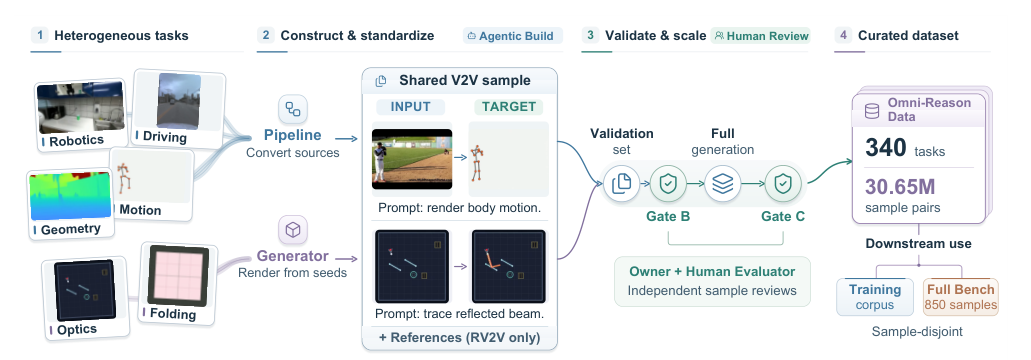
How to read Figure 4. Follow either construction route into the shared Input / Prompt / optional Reference / Target record. Gate B checks a small validation set before full generation; Gate C samples the scaled outputs for review. Only after these steps are records assigned to training or benchmark use. “Sample-disjoint” means the benchmark examples are kept separate from training examples.
- 01
Define the task
Specify what the model receives, what the prompt asks it to do and what a correct Target should show.
- 02
Review a small batch
A task Owner and an independent Human Evaluator review validation examples at Gate B.
- 03
Review after generation
At Gate C, reviewers inspect samples from the scaled output set for quality and task fit.
- 04
Hold out benchmark samples
The 850 benchmark samples are separate from the 2.31M-record training corpus.
Report snapshot: 6,800 / 6,800 automated acceptance checks passed. The report notes that 48 paired results were recomputed and the original results retained. Passing acceptance checks means the supplied report accepted those records; it is not a human judgment of task success.
TASKS / VIDEO DEMOS
Each row pairs an Input with its expected Target; some tasks also include a visual Reference. These clips illustrate the task definition and supervision format. Targets are not Omni-Reason predictions.
INPUT
TARGET
REFERENCE
No reference
Moving Cable Motion Segmentation
CAPABILITY FAMILYPSemantic perception and understanding
Prompt
INSTRUCTIONHighlight only the moving cable or hose pixels in this video using a translucent green mask color (RGB [0, 255, 0]) while preserving the original scene, timing, and background.
Task contract
WHAT A GOOD RESULT MUST DOHighlight the visible moving cable or hose using the Prompt’s color (green in this example); exclude static cables and unrelated regions.
Original objects, scene geometry and timeline. Follow visible cable regions through occlusion without filling hidden parts.
Completion guide
Five levels for judging task completion
- 5
The moving cable is fully and consistently highlighted in the requested color; static cables and unrelated regions remain unmarked, and the original scene and timing are preserved.
- 4
Main task achieved, with a localized substantive mask omission, false-positive region or temporal discontinuity.
- 3
Partly completed: important cable regions are missed, unrelated regions are marked, or tracking is persistently inconsistent.
- 2
Fragmentary moving-cable masking; most required content or relationships are missing or wrong.
- 1
No meaningful moving-cable segmentation, or unrelated output.
SAMPLE SCOPETask Atlas annotation sample S01. This is separate from the formal Bench170 evaluation sample inventory.
INPUT
TARGET
REFERENCE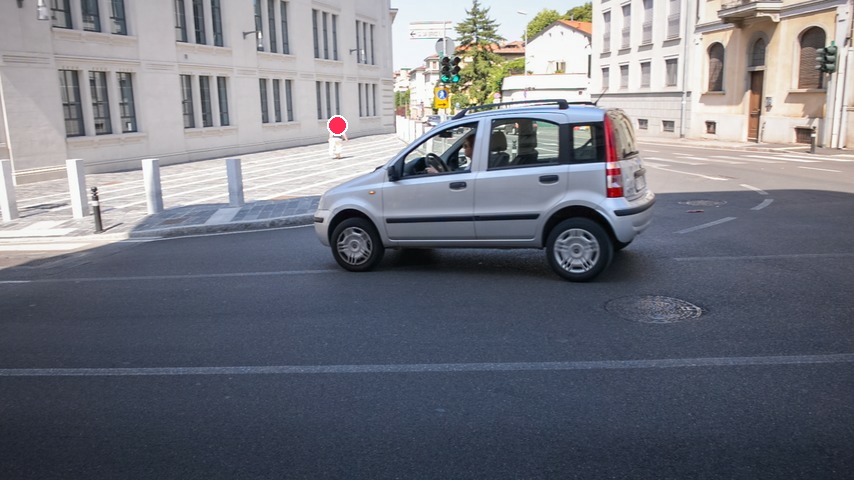
Query-Point Tracking
CAPABILITY FAMILYMIdentity, motion and interaction
Instruction summary · abridged
INSTRUCTIONTrack the exact surface point marked in the first-frame Reference throughout the Input. Show its marker only while that point is visible; suppress it during occlusion or outside the frame. Do not substitute the object center or another point, and do not draw a trajectory. Preserve the underlying video.
Task contract
WHAT A GOOD RESULT MUST DOTrack the same physical surface point selected by the Reference; show its marker only when visible and resume on the same point after occlusion.
Point identity, scene and timeline. Use the requested marker (red here), without a trajectory or a substitute object-center marker.
Completion guide
Five levels for judging task completion
- 5
The marker follows the queried surface point throughout its visible intervals, disappears during occlusion or out-of-frame periods, and resumes on that point without altering the original video.
- 4
Main task achieved, with a localized substantive tracking omission, location error or temporal discontinuity.
- 3
Partly completed: identity, visibility or point location is substantially wrong over important intervals.
- 2
Fragmentary query-point tracking; most required content or relationships are missing or wrong.
- 1
No meaningful query-point tracking, or unrelated output.
SAMPLE SCOPETask Atlas annotation sample S01. This is separate from the formal Bench170 evaluation sample inventory.
INPUT
TARGET
REFERENCE
No reference
Single-Object 3D Grounding
CAPABILITY FAMILYGSpatial structure and geometry
Prompt
INSTRUCTIONHighlight only the television monitor that is the only visible television monitor in this clip. Draw a clean red, temporally consistent oriented 3D bounding box around that same physical object wherever its visible box edges are supported by the video depth. Do not draw the box when the object is fully occluded or out of view, and keep everything else unchanged.
Task contract
WHAT A GOOD RESULT MUST DOAttach a coherent red oriented 3D box to the unique object selected by the Prompt (the monitor in this example).
Object identity, camera motion and original video, with visibility-aware box geometry. Depth and pose labels are supervision, not extra inputs.
Completion guide
Five levels for judging task completion
- 5
The requested object is correctly grounded by a coherent red 3D box whose position, extent and orientation remain consistent with the object across viewpoint and visibility changes.
- 4
Main task achieved, with a localized substantive box omission, pose error or temporal discontinuity.
- 3
Partly completed: its box placement, extent, orientation or temporal correspondence has an important error.
- 2
Fragmentary object-specific 3D grounding; most required content or relationships are missing or wrong.
- 1
No meaningful 3D object grounding, or unrelated output.
SAMPLE SCOPETask Atlas annotation sample S01. This is separate from the formal Bench170 evaluation sample inventory.
INPUT
TARGET
REFERENCE
No reference
Outdoor Video Dehazing
CAPABILITY FAMILYRVisual restoration and completion
Prompt
INSTRUCTIONRemove the haze from this outdoor video and restore the aligned clear scene while preserving camera motion, frame order, timing, framing, colors, textures, objects, and all other scene content.
Task contract
WHAT A GOOD RESULT MUST DORemove haze and restore natural clarity, contrast and color using the scene’s visible evidence.
Original objects, textures, geometry, camera motion and timeline; no invented structure. The paired Target need not be pixel-identical.
Completion guide
Five levels for judging task completion
- 5
Haze is removed throughout and natural scene clarity and color are restored, with original structures, objects, camera motion and temporal correspondence preserved.
- 4
Main task achieved, with a localized substantive haze residual, structural error or temporal discontinuity.
- 3
Partly completed: important haze, color, structure or temporal-consistency errors remain.
- 2
Fragmentary scene-preserving dehazing; most required content or relationships are missing or wrong.
- 1
No meaningful outdoor-video dehazing, or unrelated output.
SAMPLE SCOPETask Atlas annotation sample S01. This is separate from the formal Bench170 evaluation sample inventory.
Copy the BibTeX entry.
@misc{omni_reason,
  title  = {Omni-Reason: A General Video Model That Could Solve 100 Computer Vision Tasks},
  author = {Wang, Maijunxian and Zhao, Zehong and Gao, Qingying and Jiang, Zhengze and Zhang, Yilan and Qin, Huayi and An, Siyuan and Ju, Hanxuan and Wu, Yuhan and Wang, Yue and Huang, Junruo and Zhao, Lunyu and Zhao, Xin and Liu, Huayu and Li, Yihan and Wu, Jiarui and Xiao, Xintong and Wu, Shuqi and Liu, Jiajun and Luo, Evan and Zhou, Yikai and Song, Ziyan and Zhang, Haotian and Biran, Yahav and Gandhi, Kavish and Singh, Adarsh and Gray, John and Agha-Ebrahim, Armin and Burtoft, Jim and Luo, Dezhi and Yu, Fengyuan and Ji, Ran and Deng, Hokin}
}
OMNI-REASON / PEOPLE & INSTITUTIONS
Contributors
Omni-Reason is built by a research team spanning computer vision, video generation and evaluation. Authors are listed in paper order. * Project Lead.
33paper authors
12affiliated institutions
02 / AFFILIATIONS
Institutions
Universities and organizations represented in the paper.
1 University of California, Berkeley2
 University of California San Diego3
 Johns Hopkins University4
 Columbia University5
 University of California, Los Angeles6
 Nanyang Technological University7
 Carnegie Mellon University8
 Duke University9
 University of California, Irvine10
 University of Southern California11
 Amazon Web Services12
 University of Michigan
University of California, Berkeley2University of California San Diego3Johns Hopkins University4Columbia University5University of California, Los Angeles6Nanyang Technological University7Carnegie Mellon University8Duke University9University of California, Irvine10University of Southern California11Amazon Web Services12University of Michigan